
Getting Carroll County Court Records
Alan J. Lee holds one big job. He is Clerk of Superior and State Courts, and his office keeps the filed documents for those two Carroll County courts. Your first stop should be the free Tyler public index, which helps you pull a case number and docket entry fast. Georgia Courts links Carroll State and Superior e-access to PeachCourt, though that route needs an account. Need the actual file? Go to the clerk division that owns the record.
- Identify the court, case number, party role, filing period, and exact document label.
- Check Tyler for the docket entry and Georgia E-Access for the provider route.
- Choose clerk inspection, phone, mail, fax, or an accepted electronic request channel.
- State whether an ordinary or certified copy is needed and ask for a written estimate.
- Confirm delivery by pickup, mail, fax, or email, subject to the record and clerk’s rules.
You will find the clerk at 311 Newnan Street, Carrollton, GA 30117. Mail travels to P.O. Box 1620, Carrollton, GA 30112. The main phone is 770-830-5830. The Superior/State fax is 770-830-5940. The posted hours run Monday through Friday, 8:00 a.m. to 5:00 p.m. Call ahead if you hope to use a public terminal or pull an archived file. The clerk does not publish details on terminal location or off-site retrieval, so a quick call saves a wasted trip.
Who Keeps Carroll Court Records
One elected clerk serves both courts. That clerk works for Superior and State Courts in Carroll County, and the records split into distinct streams. Felony cases and adoptions live on the Superior side. So do broad civil actions, domestic relations, equity, and title matters. State Court records cover misdemeanor accusations, the ordinary traffic cases heard there, and civil matters within its jurisdiction. Land is its own world. The Real Estate division holds deeds, liens, plats, UCCs, trade names, and General Execution docket filings. Keep in mind those land records are not the same thing as a civil court case file.
| Custodian | Record lane | First contact |
|---|---|---|
| Superior division | Felony, Superior civil, domestic, equity, adoption | Clerk of Superior and State Courts |
| State division | Misdemeanor, State traffic, eligible civil cases | Clerk of Superior and State Courts |
| Real Estate division | Deeds, liens, plats, UCCs, trade names, GE docket | Clerk Real Estate division |
| Separate court office | Magistrate, Probate, Juvenile, or municipal files | The court that maintains the file |
Think of the county Open Records page as a routing chart. It points court-file questions to the elected office that maintains the records. Sending a request to the County Clerk for Board of Commissioners records will never substitute for one aimed at the court clerk.
Carroll County Court Record Types
The Carroll County docket serves as the index and chronology, while the file beneath it may hold many distinct records. Ask narrowly. Requesting "everything" can pile on review time and cost. A case number, a filing date, and the exact document label let staff locate an existing record far more quickly.
- Charging instruments, complaints, petitions, answers, and proofs of service
- Motions, responses, affidavits, and filed attachments
- Hearing notices, calendar orders, standing orders, and docket sheets
- Signed orders, judgments, dispositions, and sentencing documents
- Public exhibits, transcripts, and ordinary or certified copies when available
Access varies by item. A transcript may travel through a separate reporter channel. Reproduction may be available through the statutory process. Even so, inspecting a trial exhibit can require judicial approval. A document image might call for a provider account or a clerk request. And remember, a Tyler result is not a certified Carroll County court record.
Carroll Record Request Fields
Name an existing record. That is the first rule when you write to a Carroll County clerk. A precise request includes the court, the case number, and the caption or a known party role. It also covers the filing date or date range, the document label, your desired format, any certification need, and a delivery method. Add a phone number or email. That way the clerk can ask a narrow question or send an estimate. The office has no duty to build a new spreadsheet or an all-cases report. It also owes you no legal interpretation. Nor must it write a custom case summary that does not already exist.
| Court | Superior, State, or the separate court that maintains the file. |
|---|---|
| Case Number | The exact identifier, such as the year, court code, type, and sequence. |
| Document | Motion, order, judgment, docket sheet, or another specific filing. |
| Date | Filing date or a narrow date range that helps retrieval. |
| Copy Type | Ordinary copy or clerk-authenticated certified copy. |
| Delivery | Pickup, mail, fax, or email if the custodian permits it. |
When cost is unclear, request a written estimate before copying begins. Ask too whether the file is on-site and whether protected portions must be reviewed or redacted.
Inside a Carroll County Court Record
A Carroll County court record links filed documents to docket events. The docket might show a motion filed, a hearing set, and an order that followed. For the text itself, you need the motion and the signed order. A calendar row gives the time and setting type. It never shows the whole file. A search result can identify the case. Even so, it may shield protected information and attachments.
| Case Header | Court, case number, filing date, type, status, and public roles. |
|---|---|
| Pleadings | Complaint, petition, answer, accusation, indictment, or other initiating material. |
| Docket Sheet | Chronological entries for filings, settings, orders, and disposition. |
| Orders and Judgments | Signed rulings, directives, and final adjudicative records. |
| Service and Exhibits | Proof of service and accessible filed evidence or attachments. |
| Certification | Clerk authentication that an ordinary screenshot does not provide. |
Protected identifiers may be stripped from a public copy. Do not republish account numbers, Social Security numbers, birth dates, a child's name, or sensitive addresses just because they appeared in a filing. That they were filed changes nothing.
Docket Index or Filed Document
Three tools do three different jobs. The free Carroll Tyler index, PeachCourt access, and the clerk's certified-copy service each occupy their own lane. Tyler helps you locate Superior and State matters. PeachCourt is the mandatory e-filing provider listed for Carroll State and Superior. It may provide account-based document access. For a certified court copy, the clerk remains the source. That holds true for records not exposed as public images too.
| Item | What it proves | Where to go |
|---|---|---|
| Docket entry | An indexed filing or event appears in the chronology | Carroll Tyler or clerk |
| Filed image | The text of an accessible submitted document | PeachCourt or clerk, subject to access |
| Ordinary copy | A reproduction without clerk certification | Clerk request |
| Certified copy | A clerk-authenticated copy | Clerk or approved certification channel |
GSCCCA eCertification runs as a separate digital certified-document system, complete with account registration and authentication-code lookup. Before relying on it, confirm that the Carroll County record and office you need actually participate.
Fees and Certified Copies
A certified copy carries clerk authentication. That is what separates it from a screen capture, a printout, or an ordinary copy. Carroll County's public materials do not publish one complete current table. No single table covers every Superior and State per-page, certification, exemplification, archive retrieval, or image charge. Any generic fee figure would mislead. Ask the correct division for a current estimate. State the exact copy type you want.
| Item | Amount or action |
|---|---|
| Superior or State plain copy | Request a current quote from the clerk |
| Certified court copy | Request the certification and total cost |
| Archive or retrieval work | Ask whether retrieval applies and request an estimate |
| County Open Records policy | First 15 minutes and 20 pages free, then $0.10 per page |
The last row is the countywide Open Records policy, not a complete court-copy schedule. Magistrate and Probate publish separate fee schedules. Traffic-payment service fees, meanwhile, concern paying a balance, not copying a docket.
Clerk of Superior and State Courts
311 Newnan Street
Carrollton, GA 30117
Mail: P.O. Box 1620, Carrollton, GA 30112
770-830-5830
Four Carroll Request Channels
Carroll County gives you four ways to send an Open Records request. Pickup, mail, fax, and email are the listed delivery preferences. There is an online entry point too. For a court docket or case file, send the request to the elected clerk or the court office that actually keeps the material. Getting the right office matters as much as filling in the right fields. Review the official Carroll County Open Records request source.
The county route can help you find the responsible office. Even so, Superior and State case files stay with the Clerk of Court. Ask ahead whether that office takes a court records request by email or fax, and whether certification changes how you submit or pay. Georgia also keeps a statewide directory for online access. See Georgia Courts E-Access for Carroll County court records.
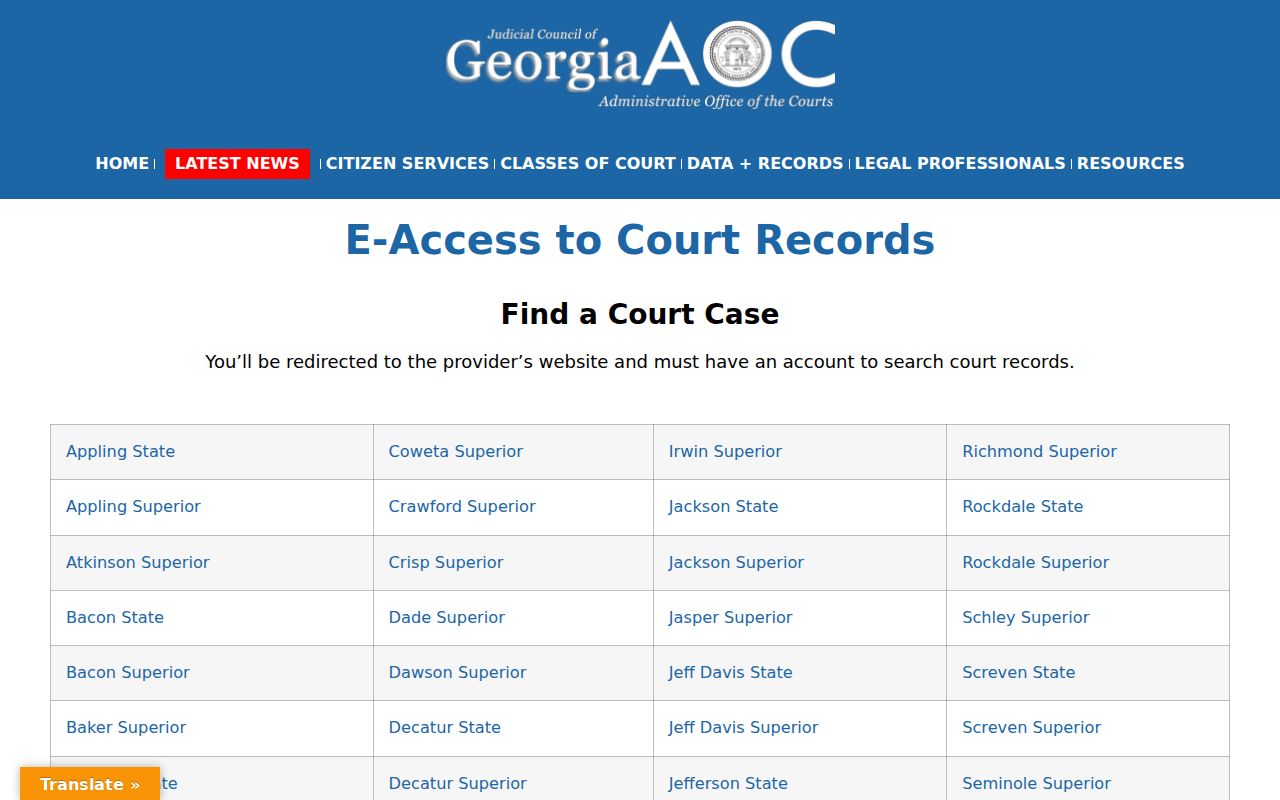
That directory sends Carroll users to PeachCourt, which requires an account. Even with one, some restricted files stay out of public view.
Real Estate Is Another Lane
Carroll County’s Real Estate division is a separate lane. It records deeds, liens, plats, UCCs, notary matters, trade names, and General Execution docket filings. A property filing alert is not the same thing as a court case alert. GSCCCA offers forward-looking notice of selected property-record activity. That tool is its Filing Activity Notification System, called FANS. Its notices are not guaranteed to be complete or accurate.
The two lanes cross sometimes. A civil case docket can mention property while remaining a Superior or State court file. And a deed or lien indexed by Real Estate is not automatically a lawsuit. So sort out first whether you want a case filing, a judgment or GE docket matter, or a land record. Then choose your search.
Sealed Records and Public Access
Two official documents spell out the state rules. The Georgia Open Records Act guide explains O.C.G.A. sections 50-18-70 and 50-18-71, covering access, response, fees, exemptions, and electronic records. The Governor’s explanation confirms that an agency need not build a new compilation for you. Court-specific laws, sealing orders, redaction duties, and custody rules still apply on top of all that.
Key access rules:
Uniform Superior Court Rule 21 begins with public court files but permits limited access under the rule’s findings and order process.
O.C.G.A. §9-11-7.1 and Rule 21.6 address protected identifiers and special protection in family-violence and stalking matters.
Georgia Juvenile Code provisions, including O.C.G.A. §§15-11-701 and 15-11-708, create separate confidentiality limits for juvenile files and records.
A blank Carroll County search can mean several things. The file may be sealed. A document may be protected, or you may be in the wrong court. A vendor boundary may be in play, or indexing may lag. Ask the office that holds the record what may lawfully be inspected. No one should promise access that depends on a judge or statute.