
Searching the Temple Court Docket
Temple's own FAQ points eligible drivers to EZ Court Pay. The clerk is the direct fallback. There is no statewide Georgia database for traffic citations, so skip any name-search shortcut. Go straight to the court that issued the ticket. Keep the full citation number, the issue date, and the cited person's exact details at hand. The court date on the papers matters too. To reach the Temple court clerk, call 770-562-3151, extension 206.
- Read the ticket and confirm it identifies Temple Municipal Court rather than Carroll State Court or a different city.
- Use the Temple-linked EZ Court Pay route only for a citation the city says is eligible for online handling.
- Enter the citation information exactly and compare any returned ticket, amount, and status with the paper record.
- If nothing appears, allow for processing time and call the Temple clerk instead of guessing at identifiers.
- For a Carroll Superior or State matter, use the county Tyler index rather than the municipal payment service.
- Verify the date, address, appearance requirement, and acceptable action with Temple before the deadline.
An online payment page is only a slice of the Temple docket. Questions about a disposition, a certified record, a reset, or a missed date belong with the court keeping the official file.
The 2025 Temple Courtroom Move
Temple moved its courtroom in 2025. A relocation notice published July 30, 2025 put Municipal Court sessions at the William Simmons Administration Building, 240 Carrollton Street, starting August 1, 2025. The date on that notice matters. Older city material can still point a reader toward a different address, so check when any document was issued before trusting it. Note the limits too. The move fixes where Temple court sessions are held. It does not fix every payment, mailing, or clerk-service instruction.
Current-location check: call 770-562-3151, extension 206 before appearing. Ask whether the question concerns a Temple courtroom session, an in-person payment counter, a mailed payment, or a record request. Use the court’s current answer over an older directory entry.
That makes the William Simmons Administration Building part of Temple's docket timeline, not just a landmark. A hearing notice printed before the move can show one place. A later city announcement can show another, and both can be legitimate.
Temple Municipal Court Basics
Temple Municipal Court handles the city's traffic and ordinance cases. Its Police Administrative Division describes a court that operates twice monthly. That helps with scheduling. It does not promise every case lands on the same docket day. The city's work sits apart from Carroll County State Court traffic cases. Felony proceedings in Superior Court sit apart too. Payment, clerk, conduct, and location guidance appear in the city's own materials. Temple posts no comprehensive public party-name docket. It posts no field-level calendar table either. So the citation plus the clerk remain the primary municipal record route. Treat empty searches accordingly. A blank county Tyler result does not resolve a Temple city citation. A missing EZ Court Pay result does not prove a county case is absent either.
Temple’s EZ Court Pay Route
Temple's official FAQ names EZ Court Pay for online payment. Georgia Courts lists that vendor among several used by local jurisdictions. The same statewide page explains why. A ticket may not show up right away. Georgia has no central citation database. Online availability can take approximately 7 to 21 business days. During that gap, the issuing court stays the authority.
| Temple channel | Best use | Important limit |
|---|---|---|
| EZ Court Pay | Eligible online city citation payment | Not a general Temple name-based docket search |
| Court clerk | Lost ticket, date, appearance, status, and record questions | Call with enough identifying detail to locate the matter |
| A payment route when the court says the citation qualifies | Use Temple’s current instructions and preserve delivery proof | |
| In person | Clerk service or approved payment | Confirm which address serves that purpose |
Temple's court-information page accepts several payment forms. But availability of a method does not mean every citation can be paid without appearing. Read the ticket, and ask before treating payment as the correct legal response.
Court Dates and Settings in Temple
Get a Temple court date from the citation, a later court notice, or clerk confirmation. Twice-monthly sessions describe general frequency, not your individual date. A reset can supersede what the citation first said. A vendor record can lag behind actual court action. Before you leave, confirm the session is at 240 Carrollton Street. Then follow the court's current reporting instructions on arrival.
| Date | The date printed by Temple Municipal Court or supplied in its most recent notice. |
|---|---|
| Time | The reporting time for the municipal docket; verify whether it is a general call or individual setting. |
| Courtroom | The researched post-move location is the William Simmons Administration Building, 240 Carrollton Street. |
| Judge | Use the judicial officer named by the current Temple notice rather than inferring a name from older material. |
| Setting type | The citation or notice may identify arraignment, trial, compliance, or another city proceeding. |
Papers showing conflicting Temple dates? Report both to the clerk and ask which one controls. And never assume an online payment cancels a required appearance unless the court says so explicitly.
Temple Court Conduct and Devices
Temple's court-information page sets out unusually practical entry rules. Food, gum, drinks, weapons, recording devices, and cameras are all prohibited. Mobile devices must be turned off. The local angle bank adds smartwatches to the device restrictions. These rules matter before you reach the Temple docket. Security and staff control entry and courtroom behavior.
Prepare for the Temple courtroom: leave cameras and recording equipment behind, do not bring weapons, avoid food or drinks, and turn off prohibited electronic devices. Call the clerk if a medical, accessibility, or documentation need affects compliance.
Watching a hearing is not a right to record it. Holding an online citation record likewise exempts no one from security screening or court decorum.
Traffic Tickets in Temple
A ticket routed into Temple Municipal Court starts with the Temple clerk. It also runs through a city-approved payment channel. The court-information page accepts Visa, Mastercard, Discover, cash, or money order. The FAQ lays out online, mail, and in-person routes. Confirm current acceptance and eligibility before sending funds, since no single amount, deadline, or procedure fits every violation. Paying and contesting are legally different things. A driver who plans to contest should follow Temple's appearance and plea instructions. Do not treat an online button as the only path. Check where the case actually sits first. A citation naming Carroll County State Court calls for Carroll County traffic tickets, not Temple's municipal vendor. School-zone citations add a wrinkle: a third-party processing route may apply. Read that notice closely. Call the office it identifies before assuming the ordinary Temple ticket path.
A Lost Temple Ticket Fallback
The official Temple court FAQ covers lost tickets, payments, and the clerk.
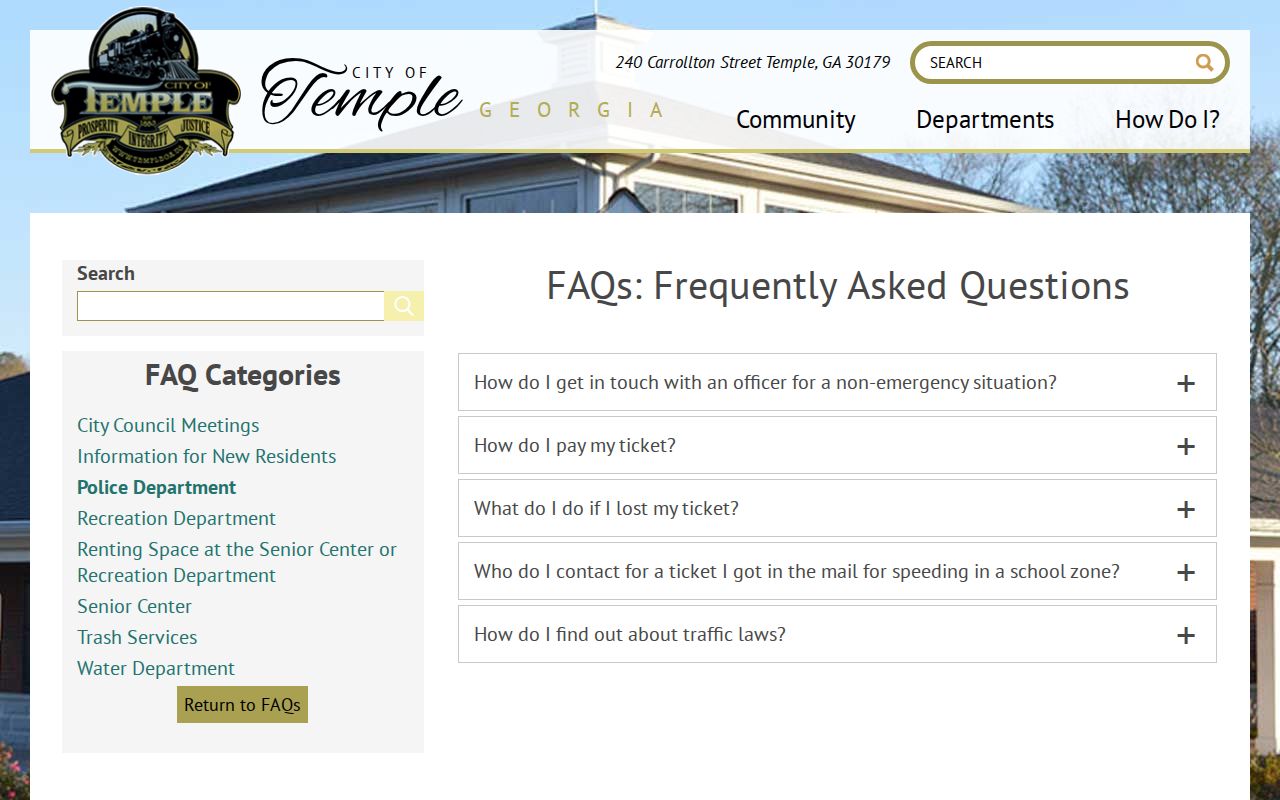
That city page tells drivers to call 770-562-3151, extension 206. That applies when a citation is missing. It also covers an online record that will not come up, and it separates mailing help from the notice about the relocated courtroom.
When you call, give the clerk the exact name on the ticket. Add the approximate issue date. Include any vehicle or violation details staff request, and any partial citation number you have. Then ask for the full ticket number. Ask for the current court date, the amount due or required appearance, and the right mailing address. Avoid guessing repeatedly in a payment system. Never send personal identifiers to an unrelated vendor. A lost paper ticket does not stop a Temple deadline from running.
Where Temple Cases Go
Temple Municipal Court keeps the records for city traffic and ordinance cases first. Some matters fall outside that tier. Even when an event happened in Temple, the case may belong to a Carroll County court instead. State Court takes misdemeanor and traffic jurisdiction. Superior Court handles felonies and general-jurisdiction matters. Magistrate may hold warrants. It may also keep limited cases of its own.
Docket flow: Temple Municipal Court › Carroll County Courts › Superior Court of Carroll County
Treat this as a routing map. It is not a promise that every Temple case moves up a level. The filing itself names the court, so read it. For county matters, the free Tyler index searches Superior and State cases. EZ Court Pay handles city citations and payments. To sort out the county-level side, turn to the Carroll County court docket instead of expecting the Temple clerk to hand over another court's record.
Temple’s Population Is Not a Docket Count
The 2020 Census put Temple's population at 5,089. That number describes the incorporated place in that census vintage. It is not a fresh estimate. It is not a Carroll-only figure. And it is certainly not a tally of Temple filings. Temple crosses county lines. The whole-place total cannot predict how many citations land in Carroll County. It cannot predict how packed a municipal session might be.
One narrow inference holds. Temple runs its own city court and related police administrative functions for a municipality of that recorded size. Wait times, session frequency, and caseload still come from current city information, never from population math.
Verify the Temple Court Address
Temple's own materials list two different addresses, and the difference matters. The FAQ ties payment and lost-ticket help to 184 Carrollton Street. It also lists a mailing route. A dated relocation notice then moves Municipal Court sessions to 240 Carrollton Street starting August 1, 2025. Both can be true at once. A clerk counter, a mail drop, and a courtroom do not have to share a roof.
Say why you are coming before you drive over. It might be a hearing, a payment, a lost citation, or a records review. Ask the clerk which address serves that purpose and what the current hours are. Before mailing anything, confirm the destination and the accepted payment form. Then keep a copy plus tracking or a receipt. That small step keeps the courtroom move from turning into a missed deadline. It can also prevent a lost request.
Temple Court Record Access Rules
Georgia's public-access framework may cover Temple municipal records. Access hinges on the record itself, the custodian, any court order, and protected information. A sharp request names Temple Municipal Court. It cites the full citation or case number, and it gives a date range. Spell out the exact docket or document you want. Say whether you need certification, and tell the clerk how you want delivery. Ask the clerk about current fees and the required submission method.
Key Rules:
Georgia Open Records Act, O.C.G.A. §§ 50-18-70 through 50-18-76 — supports access to existing public records but does not require Temple to create a new report or legal summary.
Uniform Superior Court Rule 21 — illustrates Georgia’s public court-file presumption and formal limits for defined material in Superior Court.
Rule 21.6 and O.C.G.A. § 9-11-7.1 — identify protected information that should not be copied from a public-facing record.
Start any Temple record request with the municipal clerk. If the document actually belongs to Carroll Superior, State, Magistrate, Probate, or Juvenile Court, send the request there. Do not ask Temple to fetch another court's file.